Full-stack / Applied AI / Engineering notes
HireLens
Inspect the repositoryPython / FastAPI / React / JavaScript / Supabase / Groq
What I built
I built a CV analysis workflow and tested an offline journey from upload and feedback to tracking, history, and deletion using synthetic inputs.
Key decision
separate facts from advice
Verification
Revision 187ca39: three of six authored grounded-advice cases passed. Five focused tests and seven existing evaluator controls passed. No live Groq evaluation.
Offline authored advice and mocked providers. Live authentication and Groq output quality remain unverified.
The decision, at a glance
Can feedback stay consistent across a complete journey?
- 01
Establish the score
Keep deterministic scoring separate from generated advice.
- 02
Validate feedback
Check response structure and exercise failure and retry paths.
- 03
Keep the context
Carry the result through tracking, history and deletion.
The recorded offline journey exercises upload, analysis, feedback, tracking and deletion using synthetic inputs.
Read the verification scope ↗Mocked providers and authentication. This does not establish live model quality.
The problem
CV tools can blur extracted facts, rule-based scores, and generated advice. I wanted a workflow where users can inspect feedback, understand its limits, and keep analysis and tracker history consistent.
My contribution
I built a FastAPI backend and React interface with document processing, LLM integration, a Supabase-backed workflow, and a five-language interface. The latest local pass adds output validation, ownership checks, consistent scoring/history, streaming handling, retry states, and mobile interaction improvements. The latest evidence adds an offline grounded-advice review with three negative controls.
One decision: separate facts from advice
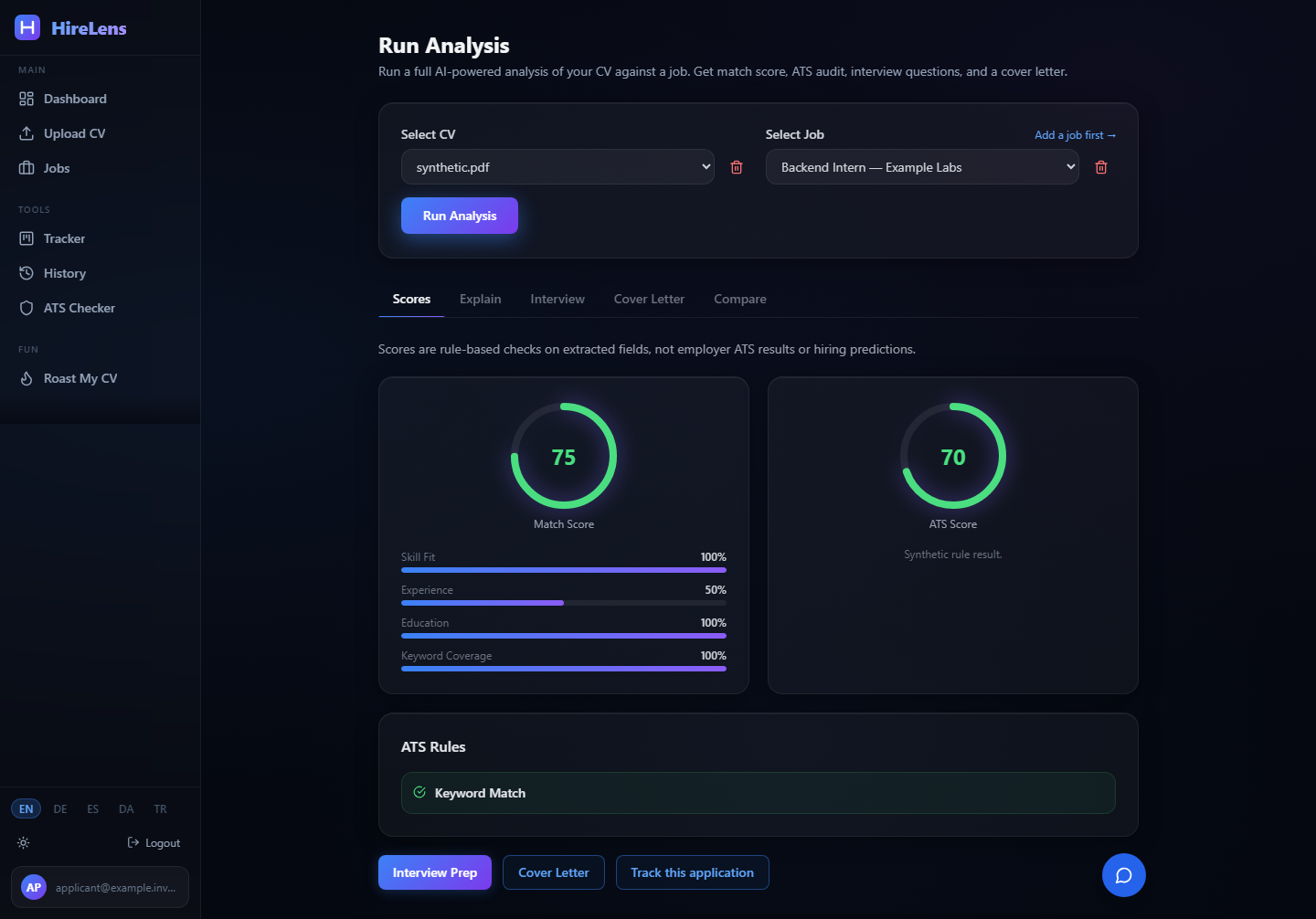
Match and ATS scores are application heuristics applied to extracted fields, not hiring predictions. Both results are computed before one history insert. Changing the CV/job pair invalidates old results; late responses are ignored. Generated advice is labeled separately, with structural checks and failure/retry states. Valid JSON alone does not prove truthful advice.
Verification and evidence scope
The earlier Linux CI run passed 43 backend tests, three frontend tests, seven authored evaluator controls, and synthetic desktop/mobile browser journeys. The inspected journey report records no browser errors, unexpected external requests, or horizontal analysis overflow. Browser authentication/API responses are mocked; separate API tests execute real routers with in-memory service adapters. These layers do not establish a live browser-to-database flow, deployed Supabase permissions, or model accuracy. Authored controls test the evaluator, not a model.
Demo
The latest local offline runner can be launched from the frontend with HEADED=1 and npm run test:journey after installing Chromium. It walks through upload validation, job input, scoring, generation failure/retry, tracker save/update, history, deletion, and sign-out. It uses synthetic identities and mocked providers, needs no API keys, and makes no live model calls. The screenshots here show that local runner; the linked repository documents the offline walkthrough.
Limits and next work
Live OAuth, Groq output quality, Supabase permissions, and email delivery remain unverified. Human review of model responses is still needed. Chromium coverage is limited to two emulated viewports and a selected journey. Parser isolation, broader accessibility checks, and dependency remediation remain priorities.